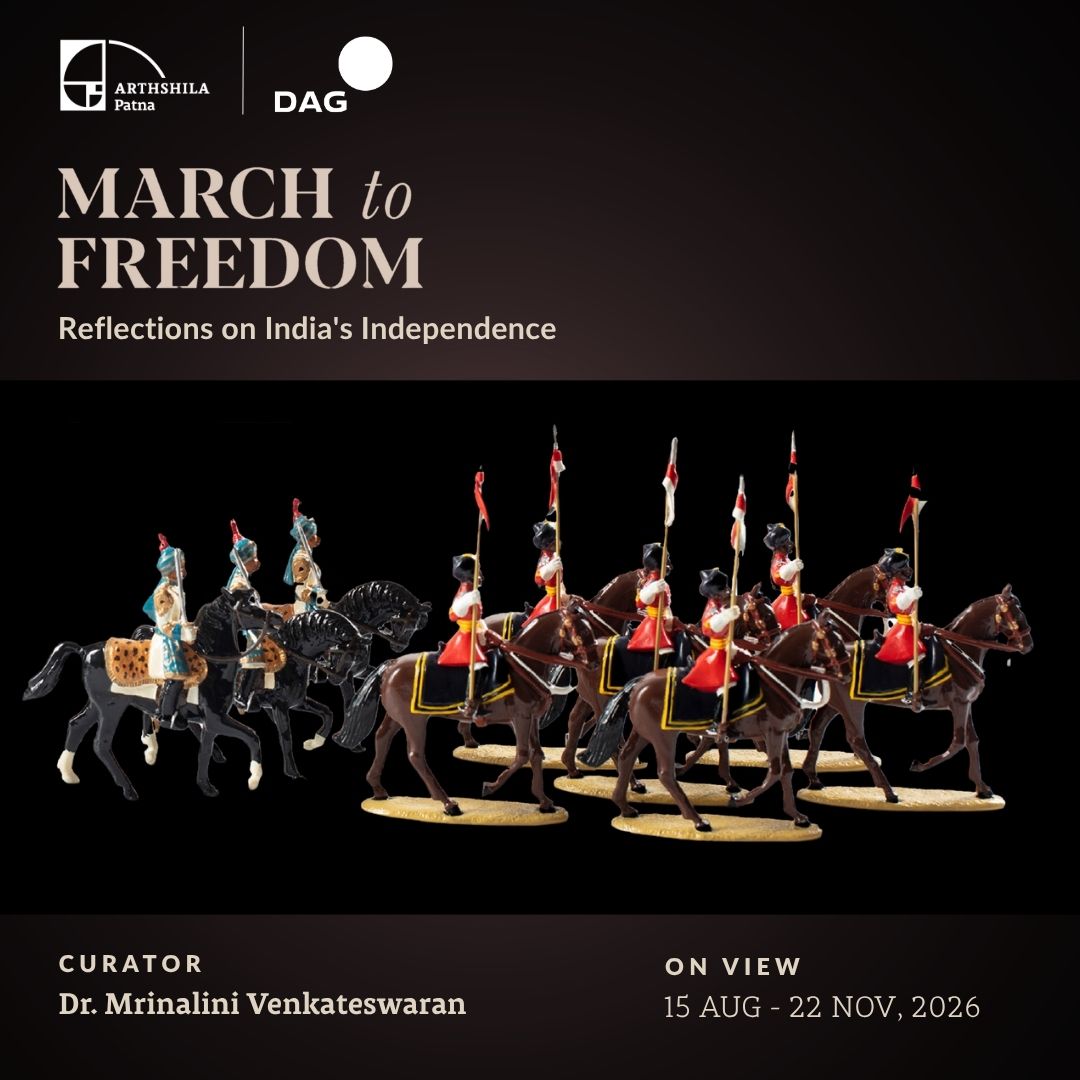
Arthshila Patna is delighted to bring DAG’s landmark exhibition March to Freedom: Reflections on India’s Independence—an exhibition that traces India’s journey towards independence through art.
Marking DAG’s first exhibition in Bihar, this significant presentation reflects Arthshila Patna’s endeavour to bring important works of art, cultural histories, and diverse artistic perspectives to audiences in the region.
About the Exhibition:
March to Freedom re-interprets the well-known story of the Indian freedom struggle and anticolonial movement through works of art and some historic artefacts. Drawn from the collections of DAG, they range from eighteenth and nineteenth century European paintings and prints, to lesser known works by Indian artists that merit greater recognition, alongside some iconic pieces. Rather than following the usual chronological path, the story is structured around eight themes. Each represents one arena, or stage, on which the anti-colonial struggle took place, to expand the story beyond politics, politicians, and battles (which also feature). Conceived to commemorate and celebrate the 75th anniversary of India’s independence, this visual journey seeks to do more. For even as we remember the struggles, the sacrifices, and the stories, such anniversaries are also occasions for reflection, including upon the scholarship that has developed on South Asian history. Some of the latter may be familiar to academics, or those with special interests. For most of the rest of us, our knowledge of this past is derived in large part from hazy memories of school lessons, which change from one generation to the next, and are influenced by concurrent national politics. We also learn from narratives on offer through public channels or in the media, to mark moments of national remembrance or controversy.
Eight Thematic Sections:
The exhibition is organised around eight thematic sections, each exploring a different dimension of India’s journey towards independence.
- Battles for Freedom: India’s independence was hard won, and fought for. It is also celebrated because it showed the power of non-violent action, a strategy that continues to inspire us, and others around the world. Not all the artworks here show battles; some show the landscapes of battle, reminding us that there was more involved than just the conflict itself, or its winners and losers. Battles also impact, and are shaped by, the people and lands in which they are fought. Stories of battle often feature heroes and villains. Sometimes, these are matters of perspective. We think of the British as the main opponents in these battles. In fact, there were many competing parties, and varied reasons for the conflicts that took place. Much of it was fuelled by quests for power and wealth, on all sides. They were also linked to international politics, the desire to control trade networks, and capture markets.
- The Traffic of Trade: Water — and our ability to navigate it — has connected people across continents through time. Whether motivated by a spirit of adventure and exploration, better opportunities for a secure life, finding new markets for trade, or by accident, the waterways of the world have brought the world to our shores, and taken India to the world. Viewed this way, our history is that of our waters: what comes in and goes out with the tides. The seas brought Roman merchants and Arab traders in search of spices and textiles, and later, European commercial companies. Fleets of ships and boats made it possible to establish colonies, and to exploit the resources of faraway lands. Fortunes have been made and lost by water.
- See India: What picture would you choose for a postcard, to send to a friend who has never been to India? We imagine India variously. For some of us, it is through sounds, smells, and colours. For others, it is about family. ‘India’ could mean food, textiles, places of pilgrimage, or particular monuments and sites that evoke it. It could be the climate, or the distinct sounds of Indian birds. It could also be through a map, and the familiar places and names on it. How did we get to know the land that is India? One answer is, through travel. People have crisscrossed the subcontinent for centuries, for a variety of reasons. The railways helped to speed things up. Although constructed as an investment with little financial return to India, Indians too used the railways, and in unexpected ways.
- Reclaiming the Past: Europeans gained control over the Indian subcontinent, either directly or through treaties with local rulers. Over time, their understanding of India’s past shaped our understanding of it. As they began to explore and write about India’s history, Europeans used the knowledge they gained to their advantage, for example, by using established practices as processions and durbars to demonstrate their right to rule. Such spectacles, fashioned by rulers to impress their subjects with their power and prestige, were a familiar language to Indians. Europeans simply borrowed it, and used it to communicate their authority as the new rulers of India.
- Exhibit India: It is through the arts — whether painting, architecture, literature, music, dance, theatre, or cinema — that human societies best express themselves, and define their identities. In consequence, suggesting the opposite – that people have no art – is also a way of denying their history and identity, and can result in their making every effort to disprove it. Although it was celebrated and sought after in the past, many in the colonial period thought that Indian art had declined, and needed rescue. Distinctions were made between ‘fine’ or ‘classical’ arts such as sculpture, painting, and literature; and ‘technical’, ‘decorative’ or ‘folk’ arts such as metalwork, weaving, and embroidery. These also intersected with gender, class, and caste divisions.
- From Colonial to National: Governing a country spread across a subcontinent is a challenge that rulers and governments of India have addressed in different ways. There are usually some common factors, like buildings and infrastructure, or systems of administration. In the 19th and 20th centuries, the courts, jails, and secretariats from which India was administered were not only places of oppression, but sites of challenge and dissent. They were spaces where ‘the public’ came together, and learned to particiapte in governnance long before we became a republic. Some sites, like the Red Fort of Shahjahanabad, were older Indian spaces that became ‘colonial,’ and then ‘national.’ In 1947, when the British moved out of the barracks built after 1857, the Indian Army moved in until it vacated the premises in 2003.
- Shaping the Nation: Mohandas Karamchand Gandhi stands tall as the father of the nation. We are all familiar with his role in our struggle for freedom, and his non-violent methods of protest that eventually forced the British to ‘quit India.’ But there were in fact many others who worked towards Independence, some of whose portraits are shown here. To succeed, the march to freedom needed people from all sections of our society to take part, and it included both men and women. The people portrayed here had very different ideas on what India meant; what freedom and independence could, and should look like. Their views were shaped by their backgrounds and experiences, as much as the world around them, the individuals they met, and the events they lived through.
- Independence: For the crowds gathered to see the national flag hoisted for the first time in an independent nation, it was a moment of celebration that had been long awaited. 15 August 1947 brought a freedom they had fought and sacrificed for. In the east and west of India, religious tensions had required former British provinces in Punjab, Assam, and Bengal to be partitioned. For those caught on the ‘wrong’ side of the new borders between India and Pakistan, Independence meant being uprooted from the lands they called home, either by choice or force, to migrate, and find a new life in their ‘chosen’ country. Many did not survive the violence that scarred their journeys, and tainted this moment.
For More Details visit: https://dagworld.com/march-to-freedom-reflections-on-india-s-independence.html